It premieres on Friday May 16, and I hope to review it here the next day. We are fortunate to have a guest post from Monsignor Eric Barr who has written an review of the film' with emphasis on it's relevance to modern Catholics.
Monsignor Barr is the Vicar for Clergy and Religious at the Diocese of Rockford, Ill. and blogs on literature and film at Anamchara.
Monday, May 12, 2008

Sunday, May 11, 2008
Literary Giants, Literary Catholics
I Recently finished Literary Giants, Literary Catholics by Joseph Pearce. I always enjoyed hearing him speak when I have heard him on Catholic radio and finally got around to getting one of his books. It now looks like I need to buy the rest of his books. I can't say I normally read with pleasure 400+ pages of essays, but I certainly did in this case. The book largely covers converts to the Church, especially from England, whose lives are often remembered by their literary output. So there is coverage of John Henry Cardinal Newman, Chesterton, Belloc, Ronald Knox, T.S. Eliot, J.RR.Tolkien, Oscar Wilde, Roy Cambell, Evelyn Waugh, and a slew of others.
The first part deals with tradition and conversion in modern English literature along with the landscape of the 20th century. From there we go on to The ChesterBelloc (I loved this section), The Wasteland which deals with the war poets and the ultramodern poets and other literary stars, a section dealing with the Inklings, and finally various essays that take as their launching pad the literary converts, but also goes into other subjects. Each of these section contain a large number of essays and while there is a lot of overlap between them, it is a positive overlap. Joseph Pearce is a fine literary writer himself and even though his specialty is biographies he has great insights into these writers and is able to write quite wonderfully about them.
It really is rather amazing how many converts there were that came from the literary world, especially the high number of conversions from the writers known as the Decadents. It is also interesting how much consternation this caused among other writers who were shocked at people like T.S. Eliot (Anglicanism) and Evelyn Waugh entering the Church. We really don't have anything comparable today of large number of literary authors entering the Church, but then again we hardly have anything comparable to the quality of these authors in the literary world in the first place. These people surely are literary giants.
I am a bit ashamed to say that if I myself had never entered the Church I might never had read any of these authors in the first place. I kept myself pretty much in a SF, fantasy, and horror ghetto and only occasionally delved into other genres. Coming into the Church I would find these other writers mentioned quite often and so started reading these authors. It is hard to imagine life without these authors now who have become like old friends to me. Though there are plenty of other authors referenced in the book that I will also need to familiarize myself with.
What I so enjoy about Pearce's writing is his enthusiasm on the subject and he pulls you in along with him into the topic at hand. It is an enthusiasm based on a deep knowledge of the authors filled with a wealth of biographical details to help you better understand their work. Highly recommended.
Wednesday, May 7, 2008
The History of Eugenics is in "Expelled"
 The dark history of the shameful movement underpinning the biggest human atrocities of the 20th century was powerfully outlined by Ben Stein in his important documentary which is a must-see for anyone serious about science, about faith, and about freedom. Did I leave anybody out?
Stein followed the scientific community's lockstep loyalty to Darwinism backwards in time, and ended up at the Nazi gas chambers, which first killed disabled people. They were just practicing Darwinism, by speeding up the process of natural selection, formerly called survival of the fittest, by eliminating "useless eaters". Society bought into this toxic mentality because it came from doctors and scientists.
Stein followed the eugenicist trail to Planned Parenthood founder Margaret Sanger, who worked overtime to rid the world of people like my immigrant grandparents. While she was ostensibly offering women choice, secretly she was seeking to rid American society of the 'unfit'. More Darwinism in action. We are still in the midst of the nightmare of Sanger's legacy; 46 million Americans have died of abortion, far surpassing the darkest dreams of Hitler and Stalin together.
Ben Stein did us the invaluable favor of holding a spotlight of truth on some of society's darkest secrets, and those valiant scientists who have dared to reveal them to academia. They were expelled from their positions and blacklisted from obtaining further employment. Oxbridge and Ivy League graduates who have produced world renowned work. They mentioned Intelligent Design once and they were gone. Nothing but strict Darwinism will be tolerated by academics. What happened to scientific inquiry and academic freedom?
Stein then exposed the utterly laughable theories of scientists who would rather make up grotesque fairy tales about Extra Terrestrials coming to earth and planting "human seeds" from which we emerged, to life's beginnings as molecules bumping together as they "rode the backs of crystals".
With his trademark aplomb and vintage film clips adding humor and highlighting the outrageous statements captured by his camera, Ben Stein has created a classic which will one day be appreciated, as the film that drew society bent on self-destruction, back from the precipice.
If it's not too late.
If we continue to allow ourselves to be dominated by dogmatically atheistic scientists whose agenda blinds them to the fact that evolution is a 150 year old theory which has NOT withstood scientific advances, we will find ourselves in a totalitarian state. The scientists themselves admitted on camera that they wish to destroy the power religion holds on culture, and relegate it to an innocuous hobby, like knitting.
Global warming and political correctness will have replaced the Judeo-Christian belief in the dignity of man, the pinnacle and master of God's creation. We will find ourselves enslaved to a materialistic ideology. Our very right to exist will be determined by what the powerful consider a worthwhile contribution to society, against our carbon footprint.
Many of us may not make the cut.
Terri Schiavo didn't.
46 million unborn Americans didn't.
See the trailer here.
Tuesday, May 6, 2008
Ever Seen the Message in a Movie? – New Catholic Website Launches
This new site is just my cup of tea. Mark has thoughtful essays that look below the surface of movies to give us insights into the bigger picture. Y'all know that I love that because it is what makes movies into art that stretches our souls instead of simply entertaining us.
A new Catholic website, SoulFoodCinema, launches today with the aim of educating and evangelising through the medium of the movies.
Soulfoodcinema differs from other faith and film websites, in that the focus is on providing education and insights for those that are curious after having watched a film, rather than providing extensive ratings and reviews for those that are curious before watching a film.
Managing Editor Mark Banks is keen to remind people that the worldwide film industry now produces hundreds of films each year that can primarily be described as ‘character studies’, and says that these films, whether we are aware of it or not, are all communicating a message to us, either implicitly or explicitly, on how to lead our lives. In such a world Mark believes it important that Catholics filled with the Holy Spirit and a love for Jesus Christ, use their wisdom, knowledge and discernment to understand these messages and to communicate them to as wide an audience as possible; especially amongst young people. For this reason Soulfoodcinema enables readers to contribute essays on one of over 700 films already viewed by the Managing Editor, which can then be published on the internet.
Soulfoodcinema also features weekly updates of links to news stories in the field of faith and film, as well as a community chat room dedicated to discussing all aspects of the movies from a Catholic-Christian point of view.
Through his letter to the Romans Saint Paul reminds us "Do not conform any longer to the pattern of this world, but be transformed by the renewing of your mind. Then you will be able to test and approve what God's will is - His good, pleasing and perfect will" (12:2). Mark asks that Catholics pray Soulfoodcinema will assist the Church in doing just that.
Sunday, May 4, 2008
Iron Man - PG13 -My own review
 Warning: some spoilers included
I took my nephews to see Iron Man today. I'm just not sure who enjoyed it more...them or me :)
They also informed me I have to take them to the new Batman the Dark Knight movie in July and the Incredible Hulk movie in June, so I'll be reporting on those when we see them :)
As many of the reviews and previews have shown, Tony Stark (Robert Downey Jr.) is kidnapped in Afganistan and forced to make a weapon. Instead, he builds a suit (the prototype for Iron Man) to escape. He owns a weapons company, and when he sees the effects of his weapons, he becomes Iron Man and vows to destroy the weapons rather than let terrorists and other bad guys have them and use them. I was impressed by that theme of redemption and atonement.
The employees of his weapons company are not exactly thrilled that the company's main product won't be made anymore. One of his executives makes a weapons deal under the table, and gets hold of the original prototype suit. He becomes Iron Man's first opponent.
As far as content warnings, there was one sex scene early on, but it was very brief and there was no nudity. There is some violence, as you would expect, and the gore is mild...some of it is actually implied, but not shown, like when some people are shot, they cut away and you hear the gunfire but don't see the death.
The part that gave me the biggest chill was to see Gwyneth Paltrow put her hand in the hole in his chest.
The biggest surprise for me was at the end. in a press conference, he announces "I am Iron Man" (usually super heros keep their true identity secret :)
cross-posted on A Catholic View
Saturday, May 3, 2008
Grand Theft Culture: The Entertainment Industry Goes for the Jugular
 Grand Theft Auto IV just came out this past week.
This review by Cullinan Hoffman would give any of us reasons to not get it for our kids. I know I wouldn't get it for my nephews.
The debut of "Grand Theft Auto IV", a highly-realistic video game in which players "win" by committing violent criminal acts, is notable for several reasons, but most importantly because of what it says about a society that is engaged in an orgy of self-destruction, and cannot even recognize what is happening.
The Grand Theft Auto series makes the player into a criminal who wins points by stealing cars, assassinating rivals, killing police, running over pedestrians, and even murdering a prostitute with a baseball bat rather than paying her. It is, in short, a game that glorifies brutal criminality and enables players to fantasize their participation in mind-numbing barbarism.
The fact alone that Grand Theft Auto IV is expected to earn more than $400 million during its run, rivaling the most popular movie releases, speaks volumes about what has happened to the U.S. during the last fifty years. What would once have seemed like a blatant and massive assault on our society by a commercial interest, is now a blockbuster form of entertainment.
Mainstream publications such as Business Week yawn at the moral objections raised against such software, and instead rave about the realistic graphics, referring to the game as "Grand Theft Awesome". "We have a hard time imagining anyone picking up this game and not feeling like this is one of the best $60 purchases they've made in a long time," says the reviewer, seemingly unconcerned that he is talking about a murder simulator.
The new version of the game and the mentality it promotes have already claimed their first victim. A man standing in line waiting to purchase the game on the first night of sales in south London stabbed a passer-by. "It was a scene straight from the game itself," said one witness.
"Grand Theft Auto", as monstrous as it is, is only a single example of the Culture of Death that is overwhelming what is left of Anglo-American civilization.
cross-posted on A Catholic View
Full Review here
Friday, May 2, 2008
Gut Check
Gut Check: Confronting Love, Work, and Manhood in Your Twenties is a interesting new book by Tarek Saab. I only recently became aware of Mr.
Tarek Saab is the son of a Lebanese father and American mother and grew up Catholic. The book mostly begins with his experiences in college and the story he tells will be familiar to many. His schooling becomes a time when faith is put on the back burner and partying and chasing after women becomes the number one priority. Though Tarek never quite loses his faith in school and would still attend Mass as more of a social thing than out of any love for the Mass. While going to school at times he evaluates his life and sees the wrong in it and then sets himself out on the right path only to stumble and fall back once again into familiar habits. Something else that many of us can relate to. He relates these periods of self-reflection and the pursuit of a belief in God.
This book follows around the course of a conversion story, but it is not an overtly apologetic one of coming to fully believe in specific doctrines and making the case for them. His story is more of someone who never quite leaves faith out of his life, but at the same time never fully lets his faith enter into his whole life. He kept his faith in a sphere separate and groups of friends within each sphere. After college he enters a Fortune 500 company and is soon on the fast track in the corporate life.
Reading through the book I was reminded of St. Augustine's "Give me chastity and continence, but not yet.", something that he also later goes on and quotes in the book. He writes in a forthright manner and is quite frank on his failings and the various episodes in his life before his fuller conversion. I found his spiritual biography to be quite insightful with many things to ponder. You could see the hound of Heaven following him and while at first he was not fully living a life as a Catholic, his Catholic faith was always there even if in a weakened state. This is a good reminder to those with children who have left the practice of the faith or have only made it a cultural expression. God is always pursuing is and there are those moments of grace when we slow down and actually let him catch us.
I found this to be a quite enjoyable read and Tarek is a good writer who could write about himself without at the same time making the book all about himself and making his story relatable to others.
Iron Man - PG13
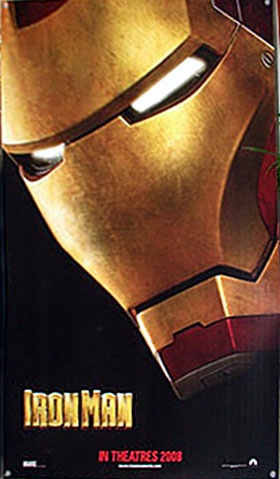 A good review from CNN
You might attribute it to 9/11, or simply blame director Joel Schumacher, whose camp take on "Batman" derailed that franchise for several years. But, lately, Hollywood superhero movies have taken themselves awfully seriously.
Iron Man
Robert Downey Jr. plays Tony Stark, a billionaire who remakes himself into "Iron Man."
Ang Lee, Bryan Singer and Christopher Nolan have produced solemn, almost morbid versions of the Hulk, Superman and Batman, respectively. Even Sam Raimi succumbed to this gravity in the "Spider-Man" trilogy.
Enter Robert Downey Jr., riding to the rescue, a glass of Scotch in his hand and a sardonic smile on his lips. As everyone knows, Downey is not the hero type. Not in his public persona and not on screen either, where his dissipated narcissism has been most often effective in supporting roles ("Zodiac," "A Scanner Darkly," "Wonder Boys").
Downey is one of those actors who likes to doodle in the margins, to ad-lib and fool around, instincts that give Jon Favreau's "Iron Man" movie an immediate fillip. The star's bad-boy past becomes part and parcel of the character's redemption drama: This is where he shows his true mettle.
One of the lesser-known Marvel heroes, Iron Man is basically Batman in a shiny new suit and a more global perspective. Like Bruce Wayne, Tony Stark is a wealthy industrialist, a weapons manufacturer with the means and know-how to create his own impregnable armor (Stan Lee allegedly based him on Howard Hughes). Iron Man made his debut in 1963, when he was captured by the Viet Cong and put to work.
Forty-five years later the theater of war has shifted to Afghanistan, but the same mechanics are in play. Stark is demonstrating his latest smart bomb -- part of the "Freedom" line -- when he falls into the hands of a murderous warlord who turns out to have a well-stocked arsenal of Stark hardware. The warlord then demands his own, homemade weapon of mass destruction.
Badly wounded, Stark feigns compliance, but actually hammers out the prototype for a bulletproof jet-suit that he uses to escape.
In the original comics, Stark's brush with mortality only made him angry; he took the war to the Commies. Favreau's reconstructed Iron Man is still a human gun, but he's no longer gung-ho, exactly. He's more of an aggressive pacifist.
Back in the USA, he announces he's a changed man, embraces nonviolence and joins a Buddhist commune. OK, I'm kidding, but not by much: He announces that Stark Industries is quitting the arms trade. As the stock plummets, he quietly holes up in his modernist Malibu home to perfect his one-man missile defense system.
True to type, Downey has a ball as the cavalier playboy in the early scenes. This Tony Stark is so much fun to be around we're almost sorry to see his transformation take place. Or we would be, if not for Downey's deliciously deft physical performance, which insists that the melding of man and machine is no walk in the park.
However, his business partner, Obadiah Stane (a splendidly bald, bearded Jeff Bridges), is unhappy about the change.
It's not difficult to guess where this is heading -- Marvel stories are all permutations on a handful of stock scenarios -- but Favreau doesn't blow it up any more than he has to. In "Elf" and "Zathura" he showed he could integrate special effects and carry the story, but like Downey, he's almost always looking for a comic spin.
A scene in which Tony invites his assistant, Pepper Potts (an appealingly valiant Gwyneth Paltrow), to reach into the hole in his chest and fix his battery is a cheeky cocktail of trust, disgust, love, sex, fear and courage (it's also a key plant for subsequent developments), but above all it plays funny. When a movie is firing on all those cylinders, you know it's a winner.
The character stuff is so light on its feet that the action scenes seem flat in comparison -- the effects are first-rate, but they're nothing we haven't seen before, and the climactic showdown is a bit heavy-handed (if satisfyingly crunchy).
Even so, "Iron Man" is a supremely confident, well-tooled entertainment. It's bound to be the early pace-maker for the oncoming glut of summer blockbusters.
source here

Movie Review: Cloverfield (2007)

Short Review: MTV makes a monster movie.

The whole movie is held hostage by its own novelty. The hook for the flick is that a giant monster attacks New York City and the whole thing is caught on tape by civilians on the ground. This may seem like a great premise for a film until you learn that this means you'll spend ninety minutes with a gaggle of vacuous snot nosed twentysomethings who can't hold a camera still. If you're even remotely prone to seasickness or enjoy films that involve character arcs and plot, you want to steer clear of this pointless mess.
The story is cobbled together to keep the novelty alive. Since the characters need to keep filming for there to be a movie, screenwriter Drew Goddard is forced to have them make foolish choices or be the victim of ridiculous coincidences. Honestly, the monster seems drawn to recognizable land marks and only seems compelled to destroy them once the heroes get within range to shoot the carnage. Goddard's plot is frustrated by having to keep his story alive under the conditions of the gimmick. Since the characters would logically try to avoid the lumbering giant monster Goddard has to invent a way for them to remain in peril even when hiding. His answer? The giant monster sheds evil spiders that impregnate people and makes them explode. This stupid concept may have been cool on paper but in reality all we get is the characters being assaulted twice in quick scenes that are all filmed with a shaking camera. There's no reason given for any of these monsters, but then again, there's no real reason to provide one. This isn't supposed to be Shakespeare. Too bad its not even good enough to claim to be Stephen King. You can forget this mindless drivel and go rent Godzilla - at least he didn't poop spiders.
Cautions: There's some gore, although it is brief. Swearing abounds and there's a ton of death. This isn't for small children obviously...then again, with how stupid this is, it's not for adults either.
Worldview: There has been some fleeting comments pointing out the tenuous connections between this movie and 9-11. Fair enough, let's look at it. The opening of the film, when the monster strikes it breaks up an oil rig, and then comes to New York and beheads the Statue of Liberty. Following this, it knocks down some prominent skyscrapers choking the streets with huge billows of dust and smoke. The citizens huddle in small shops as the devastation passes by. One can easily look at all of this and see linkages to the images of 9-11.
Even though they appear to be mindless and without meaning, horror movies are loaded with symbolism and messages, usually these are intentional. One of the staples is what i call "the death of God" at the beginning of a movie. When a monster first attacks it is normal for it to kill a priest, destroy a church, or defile another religious symbol. What is the first thing blown up in Steven Spielberg's War of the Worlds? A Church. Where does Jim, from 28 Days Later, discover the zombies? A Church - and the first person he sees in zombie form? A priest. Even Wallace and Gromit: Curse of the Were-Rabbit has the first victim of the beast be the town Reverend. The next time you watch a horror movie watch for this image. What is happening here is the evil is transplanting itself in place of God. Without God there is no hope. In this film, this usual religious movement is altered and it is the Statue of Liberty - the world's biggest symbol of freedom - that is toppled. This is how I can make a connection between this film and terrorism. Now that I explain all of this, I should add that the film, being a senseless pile of crud, doesn't do anything with this symbolism. Following these striking images, the movie falls into a tedious first-person yarn that can seem to decide how its going to resolve itself.
Before I go, I just want to add that it is just bad film making to have a disaster film set in New York City and have crowds of people running and there's no children in any of the shots. Heck, there's barely any minorities or old people. According to this movie Manhattan is populated by handsome whites between the ages of 18-26 and their hot black girlfriends. Cheap film making.
Thursday, May 1, 2008
Book Review - Christ the Lord: The Road to Cana

Christ the Lord: The Road to Cana
by Anne Rice
by Anne Rice
[Jesus speaking to the devil in the desert]If I were to excerpt all the sections that presented new, stirring, and inspiring ways to consider Jesus as fully human and fully God, I would have to include about two-thirds of this book. Time and again I was astounded at Anne Rice's mastery of delicate subtlety in conveying a truth in her meditation of Christ among us as he comes to his ministry.
"Those aren't your nations," I said. "The kingdoms of this world aren't yours. They never were."
"Of course they're mine," he said. It was almost a hiss. "I am the ruler of this world and I always have been. I am its Prince."
"No," I said. "None of it belongs to you. It never has."
"Worship me," he said gently, beguilingly, "and I will show you what is mine. I will give you the victory of which your prophets sang."
"The Lord on High is the One whom I worship, and no one else," I said. "You know this, you know it with every lie you speak. And you, you rule nothing and you never have." I pointed. "Look down, yourself on this perspective that is so dear to you. Think of the thousands upon thousands who rise each day and go to sleep without ever thinking evil or doing evil, whose hearts are set upon their wives, their husbands, their fathers and mothers, their children, upon the harvest and the spring rain and the new wine and the new moon. Think of them in every land and every language, think of them as they hunger for the Word of God even where there is no one to give it to them, how they reach out for it, and how they turn from pain and misery and injustice, no matter what you would have them do!"
"Liar!" he said. He spit the word at me.
"Look at them, use your powerful eyes to see them everywhere around you," I said. "Use your powerful ears to hear their cheerful laughter, their natural songs. Look far and wide to find them coming together to celebrate the simple feasts of life from the deepest jungle to the great snowbound heights. What makes you think you rule these people! What, that one may falter, and another stumble, and someone in confusion fail to love as he has striven to do, or that some evil minion of yours can convulse the masses for a month of riot and ruin? Prince of this world!"
"I'd laugh at you if you weren't unspeakable. You're the Prince of the Lie. And this is the lie: that you and the Lord God are equal, locked in combat with one another. That has never been so!"
He was near petrified with fury.
"You stupid, miserable little village prophet!" he said. "They'll laugh you out of Nazareth."
"It is the Lord God who rules," I said, "and He always has. You are nothing, and you have nothing and rule nothing. Not even your minions share with you in your emptiness and in your rage."
He was red faced, and speechless.
Some reviewers have mentioned their difficulties with various aspects of events portrays in village life such as a stoning or of Jesus' attraction to a local maiden. However, for me these were believable incidents. Perhaps that is because I was prepared by having read Two From Galilee by Marjorie Holmes long ago in my truth-seeking days. I enjoyed that book, and the sequel as well, but those books contain nothing near the power and insight that Rice has when conveying Jesus to us in everyday life. I especially enjoyed the contrast between his tendency to "hang back," as his relatives termed it, while still being able to love and appreciate the people around him. Even when being chewed out by a fellow villager, Jesus can still appreciate the beauty with which the enraged fellow gesture. This gives us the feeling that he can always find something to love in his fellow man, even when we would not under similar circumstances.
The vivid contrast between "hanging back" and his sudden assertive command after baptism is definite and startling. We see this emerge in the way Jesus speaks with the devil in the desert and then later when he is asserting that the Messiah is working in time to bring God to everyone. One gets a sense that in Jesus' complete trust and willingness to do God's will, that he is becoming fully "himself" and all is becoming clear to him on the journey.
Rice's writing is so masterful that readers may need to remind themselves that these are personal meditations of Jesus' life. She makes remarkably few false steps and these are not a matter of lacking adherence to the truth as much as when her personal meditation may not match step with those of the reader.
It is no secret that I did not enjoy the first book in this series (Christ the Lord: Out of Egypt), as the midrash felt false and forced to me. Therefore, I was stunned but quite pleased to find this book such a personal revelation of inspiration for my own meditations on Jesus. Anne rice has given us a treasure if we use it wisely. Personally I can tell you that it will be going into my regular rotation of meditative reading to provide ongoing food for thought.
I wish I could write as good a review as this book deserves. I cannot. All I can do is to exhort you to read it for yourself. And, of course, to thank Anne Rice for sharing her talent in this area.
Highest recommendation.
Subscribe to:
Posts (Atom)


 Posts
Posts


