Thursday, July 31, 2008

Saint Batman?

cross-posted from A Catholic View

Some insightful commentary from Fr. Raymond de Souza. He greatly expands on some of the questions I had as I watched The Dark Knight.


Heath Ledger is mesmerizing in The Dark Knight, the latest Batman film. Here in his Australian homeland, his posthumous appearance as the Joker has been a major news story for two weeks.

It's an extraordinary film, even if you are, inexplicably, unmoved by the addition of futuristic gadgets to the most reliable blockbuster combination in cinema: explosions, firearms, car chases and more explosions. This Batman comes with the bonus of some of the more combustible questions in philosophy. What is evil? Is there a moral order built into our world, or is to speak of such a moral design delusional?

This Joker does not permit us to dismiss him as delusional; he comes with an argument. This is not the maniacal buffoon of Jack Nicholson's star turn nearly 20 years ago. This Joker is diabolical.

story here


portrait from Dan Lacey at Faithmouse

Wednesday, July 30, 2008

Book Review: Audrey

When you read the pages that follow you will see how Audrey was privileged to have that heightened sense of God's presence, and how that led her to do things "here and now" (learning her French verb tables, doing a sacrifice to console Jesus...) ... But the most winning thing about Audrey is that she doesn't lecture you. She just seems to invite you to sit down on that hospital bed beside her, she cuddles up to you like any little girl her age, and with the simplicity and depth of her actions she invites you and shows you how to love more sincerely, more simply, more completely. ...

I am sure you will enjoy reading about Audrey, and I am also sure that something in this book will change you.
Father Anthony Bannon, from the introduction to Audrey
I told Chris Cash from The Catholic Company "surprise me" when he wrote asking what book I'd like. He did. I inwardly groaned when I received Audrey -- True Story of a Child's Journey of Faith. One look at the title tells us that we are looking at a story about a "holy little one" who surely has died from some lingering illness or other. I was falling prey to the standard preconception (imagine that! my besetting sin, surely) about how holiness is shown. Never having a connection with St. Therese of Lisieux, her story nevertheless flashed through my mind and I resigned myself to reading a saintly, "too good for this world" story. However, I'd agreed to read and review the book so I picked it up and prepared to soldier on.

"Audrey" exposed me to a sort of holiness I'd never seen so well expressed as in this book. As recounted in a series of vignettes, we see how Audrey naturally expressed God's grace in her life from the time she was a small child. Her parents' repeated mystification at this in their faithful but normal family, her siblings' lack of a similar gift, and Audrey's own very human nature all serve to emphasize just what a gift of God this was. Gloria Conde's skill at unveiling Audrey's joie de vivre and growing faith are apparent as we, too, come to see and believe Audrey's self-sacrificial love for Jesus, her pouring out of herself in prayer for others even as she suffers physical pain.

Perhaps most telling of the fact that Audrey's faith is God's doing, is her mother's sudden realization that the most famous child saints she could think of had all suffered trials from illness. Following this presentiment came the painful diagnosis of leukemia. It is then when we see Audrey's faith blossom and how others in praying for Audrey are actually blessing themselves. I was especially touched by her small brother's satisfaction in being allowed to suffer for his sister when he is chosen as a bone marrow donor. His mother perfectly captures the feelings of a heroic boy tilting at dragons for Audrey's sake. As well, in the midst of pain and suffering, we are not allowed to forget Audrey's human side. The practical joke she plays on a nurse soon after being put into a sterile bubble makes us laugh and remember that Audrey is still a child with high spirits that cannot be quenched.

Told in an unsentimental style, Audrey's story contains great grace, courage, and faith. It is one that I highly recommend to others, especially if they, like me, cynically doubt a small child's holiness except as a reflection of others' sentimental projections. Audrey is the real deal. This morning I found myself asking for her intercession for a special intention as well as thoroughly enjoying thinking of her getting to know our two children in heaven. I will not soon forget her story ... or her prayer from shortly before she died.
For mothers who have lost a child, so that they will understand that this child of theirs is a small servant of Christ in heaven.
Father Bannon was right. This book has changed me. Thank you, Chris, for choosing better than you knew.

This review was written as part of The Catholic Company product reviewer program. Visit The Catholic Company to find more information on Audrey - True Story of a Child's Journey of Faith.

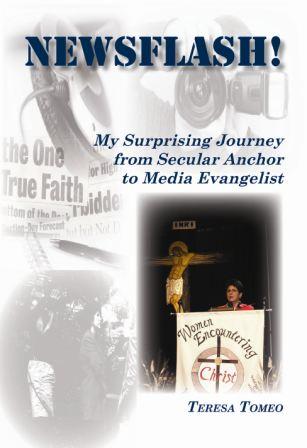
Newsflash: Not for Wimps

Cheryl Dickow discusses Teresa Tomeo's latest book Newsflash!, which is an autobiography.

Newsflash! is Teresa’s powerful testimony, in which she shares her public and private tragedies and triumphs. Like Archbishop Chaput’s message, Teresa’s isn’t for the faint of heart: she calls each and every Catholic to live out his or her baptismal vows in a more conscientious way. As Teresa pointedly admits, “Being a Catholic isn’t for wimps!”

Teresa begins by sharing a key event behind the telling of her story: the suicide death of a friend and former colleague. Teresa then takes her reader behind the scenes of the life of glitz and glamour that is secular television, to give the reader a sense of what this dear sister-in-Christ had experienced. Once behind the scene, Teresa tells of her own very public fall from fame, when she was unceremoniously fired as a secular anchor, and then the ensuing road to recognizing and accepting God’s graces.

cross-posted on A Catholic View

story here

Thursday, July 24, 2008

Book Review: The Shack

The Shack is a book I was peripherally aware of but never intended reading. It is one of those "inspiring" Christian novels that seem to be always floating out there in conversation and on blogs. I rarely am interested in them as they usually have both sloppy writing and sloppy theology. (Hey, let's tell it like it is ... we hoe a Catholic row 'round here!)

Then a friend told me how much she liked it and lent me her copy.

Essentially, The Shack is the story of a family that has suffered the tragedy of having their six-year-old daughter kidnapped and murdered by a serial killer. They are suffering from all the reactions one can imagine, from intense sadness and guilt to extreme anger with God for allowing this to happen. Mack, the father, finds a mysterious card in the mailbox one day. It appears to be from God and invites him to come to the shack where the last evidence was found of his daughter, a blood-stained dress. When Mack gets there he encounters the Trinity in a Narnia-style adventure that strives to inform about God and our relationship to Him.

With one eye open for things that would lead me away from Church teachings, I plunged in. This is clearly a book written by someone who has not studied the craft, but who is passionate about how we can better be in a relationship with the Father, the Son, and the Holy Spirit. I found much to praise, inspire, and ponder in the first two-thirds of the book. The author's own obvious enthusiasm is communicated to the reader in an imaginative setting that helps the reader to grasp a bit better the Trinitarian God, Jesus as fully human and fully God, and our relationship to God as humans. At times this dips far enough into sentimentality while making a point that it leaves the reader wincing. However, overall I was intrigued and swept up in the way that love and relationship with God were being expressed and explained to Mack. I especially enjoyed the personification of the Trinity and that of Wisdom. (On a side note, I would be very curious to hear from any well-catechized Catholics who have read this and could comment on how this view of the Trinity falls into line with Catholic teachings.)

There were some glaring problems in the last third of the book, however. One such problem is in the author's lack of honesty in story telling when Mack finally asks Jesus about his daughter's fear and suffering at her kidnapper's hand. In a story that is supposedly about how one deals with true evil in the world, the answer glossed over any semblance of reality in a fashion that practically screamed "I can't answer this so let's just not deal with it." The author lost a golden opportunity to do some real good in giving people a chance to wrestle with this issue.

Additionally, when Mack leaves the shack and reenters reality, the family's story is sped to a satisfactory conclusion a la, "a shot rang out and everyone fell dead." As the essence of the book is found in the shack this can be understood but it left a somewhat unfinished feeling for this reader.

However, as I was not expecting much literary virtue from the author in the first place, my main problems came from the divergences between his representation of Christianity and mine as a faithful Catholic. The book suddenly takes a turn into an almost New Age mentality and I'm not just talking about the night scene where Mack is given the gift of "true sight." There is a repeated disdain expressed especially by Jesus for churches and religion as "institutions" and "buildings." Jesus tells Mack at one point of his love for his bride, the Church. He then explains that he isn't talking about what people call "church" but about every person who believes and has a relationship with him ... including Muslims, Buddhists, Hindus. While I am on board with the idea that other faiths have relationships with God (as is the Catholic Church), as a Catholic I know that we have Jesus present with us in the Eucharist. This is not simply symbolism but true presence, body and blood, soul and divinity. That is the entire reason for the Church and for any Catholic church building in the first place ... as a meeting place with Jesus in physical form. Even taken from the Protestant understanding (as I am aware of it) this is a clear disdain for the church as "community," which is what God has been talking about for a good portion of the book. Despite the "broken world" explanations given to Mack, one winds up with the feeling that if we would all waft through life just loving God and being all that we can be, then eventually we'd all wind up holding hands and singing together.

Once I read The Internet Monk's review and discovered that the author is of the "emergent church" persuasion much more about the problems I had became clear. I encourage you to read the Internet Monk's review which reflects much of my own reaction to the book. Here's a bit, but please go read it all.
Young is not a master of elegant prose (though his descriptions of the indescribable are well done), but he is wonderfully passionate about the love of God. This is a book that will leave certain aspects of the Gospel indelible impressed on the reader: the nature of the Trinity, God’s personal love for us, the meaning of trust and forgiveness, and the constant creative presence of the Holy Spirit. Young takes many chances, and while not all of them pay off equally, those that do are pretty magnificent. ( I can’t remember setting in a classroom and being moved to tears by a novel before, certainly not one in the “Christian” market.)

Those inclined to look for emerging church error or general heresy won’t be disappointed, and I am sure Young enjoys some of this theological and traditional mischief. I’d recommend putting up the doctrine gun for the duration of this book, and letting the story entertain and explore. This isn’t a confession or a catechism, but it is something a lot of people will read and absorb. It is difficult to not be drawn into the central character’s “Great Sadness,” and the transforming experience that sends him back into the world a changed man is one all readers will find themselves envying. If you can read this book as what it was meant to be, and not as a chapter of someone’s Systematics, it will work on the level we most need such a story: our own sense of intimacy with God.
I did enjoy this book and definitely am going to reread it, if for no other reason than many of the things in it are true and inspiring. However, this is a work of fiction and the reader is warned not to swallow the author's occasionally dubious theology whole and adapt it as their own. As the Internet Monk says, it is a work that can help inspire our own intimate relationship with God. If we take that message and actually use it in our prayer and daily life, not merely read it and feel good, then The Shack can be of great use to any Christian.

Wednesday, July 23, 2008

Holy Moses! PBS documentary suggests Exodus not real


cross-posted from A Catholic View

Once again, secularists take it upon themselvs to rewrite our faith.


Abraham didn't exist? The Exodus didn't happen?

The Bible's Buried Secrets, a new PBS documentary, is likely to cause a furor.

"It challenges the Bible's stories if you want to read them literally, and that will disturb many people," says archaeologist William Dever, who specializes in Israel's history. "But it explains how and why these stories ever came to be told in the first place, and how and why they were written down."

The Nova program will premiere Nov. 18. PBS presented a clip and a panel discussion at the summer tour of the Television Critics Association.

The program says the Bible was written in the sixth century BC and that hundreds of authors contributed.

"At least the first five books of the Bible come together during the Babylonian exile," says producer Gary Glassman.

The program challenges long-held beliefs. Abraham, Sarah and their offspring probably didn't exist, says Carol Meyers, a religion professor at Duke University.

"These stories are unlikely to represent real historical events, but rather there's some kernel of ancient experience in there which has survived and which helps give identity to the people at the time the Bible finally took shape centuries and centuries later," Meyers says.

story here

Monday, July 21, 2008

In Plain Sight -Don of the Dead

Warning: contains episode spoilers

I happen to like a few of the series on USA Network, including "In Plain Sight", about an agent, Mary Shannon, in the Witness Protection Program. Last night's (7/20) episode, was"Don of the Dead". It opened with a married Catholic couple, Don and Ruth, meeting with a priest, because they really can't stand each other anymore, and they really don't meet the conditions necessary for an annulment. They also witness the murder of that priest, which is why they are now in the Witsec program.

Together, they started, and continue to run, a soup kitchen. They stay together because they feel that it was God's will that they were married, and Ruth won't divorce, and they can't get an annulment.

When Mary is questioning why they didn't just divorce, she reveals that she too is Catholic, which was never mentioned on the show.

When Don is found dead, Ruth's true feelings are revealed: she really did love him. After it is discovered that the deceased was an alcoholic, Mary finds out that Don is not really dead. In the end, he decides to remain "dead" to give Ruth a chance to find real happiness. He says "she deserves it".

I was struck by Ruth's faithfulness to the Catholic Church and Catholic teaching. Both Ruth and Dan seem to be very good people who live Christian lives. They cared for eachother more than they realized.

cross-posted on A Catholic View

If you'd like to see this episode, you can see it online at the site below.


Sony's new group; The Priests

Three Irish parish priests have one love besides the Lord; traditional Catholic music. Father Eugene O'Hagan, Father Martin O'Hagan, and Father David Delargy have been singing together since childhood but never took their talent seriously until their studies brought them to Rome. Now they have signed a contract with SONY and may be the next big religious hit since the "Chant" CD topped the European charts.
Listen to their rendition of Ave Maria and O Holy Night and visit their website here. Their superior musical gift is apparent, and traditional arrangements reflect their background in Church history. They are authentic and uniquely talented to re-present traditional music at a time when the Traditional Mass is making a comeback. I wish them every success, and will be looking forward to their first New York concert.

Sunday, July 20, 2008

Batman: The Dark Knight - PG-13

Warning: Possible Spoilers

Although my nephews and I all enjoyed the latest Batman story, I really don't think it lived up to the hype surrounding it.

There is plenty of action and violence, mostly explosions.

Heath Ledger is indeed brilliant as the Joker.

One of the aspects of superhero movies that interests me is the origin of both the hero and the villains; how they became who they are. In the case of sequels and remakes, I find it interesting to compare how they handle the telling of that aspect of the story.

They specifically indicate they have no idea of the Joker's background, his DNA, fingerprints, or any other information. (in the Michael Keaton/Jack Nicholson Batman movie, we see Jack Napier fall into a chemical vat, causing him to become the Joker).

Right after Rachel Dawes agrees to marry him, we see DA Harvey Dent become Two Face after the Joker leaves him with drums of chemicals, which run over his face, causing him to becomeTwo Face. (In the Val Kilmer/Tommy Lee Jones Batman movie, we only see a brief flashback reference to a criminal throwing acid at Dent, causing him to become Two Face.

I found it sad that Batman, who fights criminals, was so afraid of becoming the villain.
Harvey had said to him "You either die a hero or live long enough to become the villain". He seemed to be really be afraid of that happening to him. Considering how the Joker was able to turn Harvey, who was also considered a hero, into Two Face, The underlying theme seemed to be the idea of good succumbing to evil. It was good to see Lieutenant Gordon get promoted to Commissioner.

I didn't care for all the loose ends the ending left.

What happened to the Joker? (although they may have had to leave his fate unknown, because there is an indication that he will be back).
How/when will Batman be back? (We see him ride away at the end, but you know they'll be a sequel :).
Will Lucius Fox be back?
I don't mean to sound too down on The Dark Knight, it really was a cool movie.
Your comments welcomed!


cross-posted on A Catholic View

http://thedarkknight.warnerbros.com/


Thursday, July 17, 2008

A Place to Report Email Spam Related to Child Pornography

A reader was good enough to alert me that there actually is a place where you can report email spam related to child pornography.
I get a LOT of spam on my work email account -- they use Yahoo business service. Too many of them are porn spam.

But this evening I received a spam advertising Web sites for child pornography. I won't go into details of what it pitched, but it listed 5 Web sites with Russian domains.

I was so disturbed by this, I couldn't just delete it (which I do with the rest of the spam). After some research, I discovered that it is possible to report cases on even email spam related to child pornography.

In case anyone else might receive this kind of spam, I thought it would be good to at least let them know it can be reported.

The CyberTip line of the National Center for Missing & Exploited Children will collect reports of child pornography spam.
I applaud this reader's initiative. I am fortunate enough to not have this sort of thing coming through our email filters but I know it is an increasing problem so am happy to be able to tell about this resource.

Why is the Ghetto Culture is glorified in the Media?

Wheelie Catholic wonders why there is a fascination with violent crime in the media, particularly in video games like "Grand Theft Auto", in light of the Holy Father's comments on consumerism at World Youth Day. "Why have we turned social problems into entertainment? What kind of distance from solutions does that cause for the next generation? Does it normalize the existence of violence and poverty in urban areas? Have we considered the concept of stewardship regarding monies we pay toward products that glorify violence rather than putting it toward solutions?"
I worked for years teaching in inner city high schools like those she describes. The teens in these areas have no hope for a better future. No one they know is married, gangs rule their social lives, and many of their friends are drug addicted and in and out of jail as a peverse type of second home. I had a student commit a crime in order to spend Christmas with his friends in jail, but get out in time to go to the beach in the summer.
They often lack fathers to discipline them, little or no Christian faith to believe in an eternal reward, and few with the tough love to teach them moral behavior. They accept and even embrace the culture of crime as their reality, perhaps despairing of a better life. Who could blame them for feeling despair?

What frightens me is when so called middle class kids, mostly from broken homes, glorify crime, violence, gangs through video games, film and RAP music. According to Ebony magazine, over 80% of Rap musis is purchased by whites. Here in semi-rural suburbia, my 15 year old daughter passed a schoolyard walking the dog, and was verbally accosted by a young man with blonde hair whose trash talking came straight from a RAP video. Why did he think he would impress her with this kind of talk? To her credit, he didn't.
The Holy Father pointed out in his talk to the youth at Dunwoodie, that these youth, both within and outside the inner city need the hope of the Gospel and the reclaiming of the culture from the culture of crime. Catholics must never support this types of entertainment which seek to glorify the suffering of the poor, regardless of the misguided souls who find a sense of pride in it.